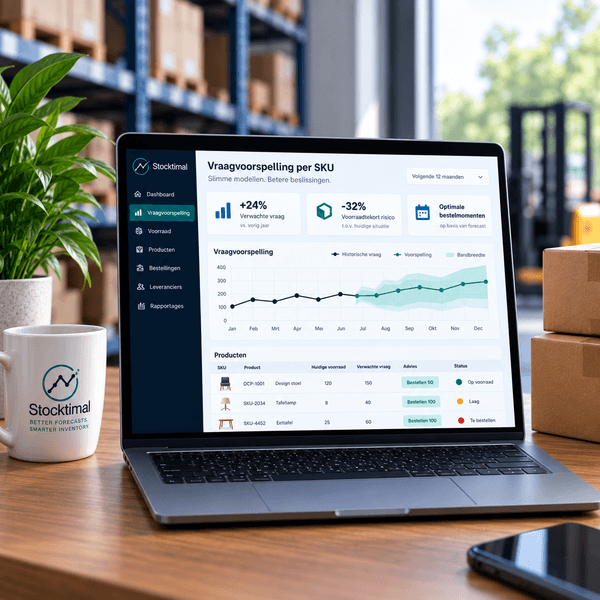
Demand planning is the process by which an organisation forecasts future demand for its products in order to align stock and purchasing as closely as possible. Good demand planning helps you prepare for changes in demand and limit both stock-outs and excess stock. This blog explains what demand planning involves, how it works, and why it matters for effective inventory management.
This blog in short
- Demand planning is about forecasting future demand for products.
- Historical sales data, trends and seasonal patterns are key inputs for a forecast.
- A reliable demand forecast supports better decisions on stock and purchasing.
- Demand planning and inventory optimisation work together, but they are not the same thing.
What exactly is demand planning?
Demand planning is the practice of estimating how much demand there will be for a product in a future period. This is usually based on historical data, supplemented with relevant information such as trends and seasonal patterns.
The result is a demand forecast: a prediction of future demand. Organisations can then use this forecast as the basis for decisions on purchasing, stock and production, among other things.

How does demand planning work?
Demand planning starts with collecting and analysing relevant data. Historical sales figures often play a major role here. Patterns in this data can help produce a better estimate of future sales.
A forecast is then drawn up based on this information. That forecast is not a one-off. As new sales data becomes available and circumstances change, the forecast can be updated. Demand planning is therefore an ongoing process in which forecasts are regularly compared against actual demand.
Which data matters for demand planning?
Historical sales data is often the starting point, but not every product follows the same demand pattern. When building a good forecast, it is therefore important to look at which factors actually influence demand.
Think of seasonal patterns, structural trends and unusual sales spikes. A temporary spike, for example, should not automatically be read as structural growth, since that can distort future forecasts. Properly assessing such deviations produces a more realistic picture of future demand.

Why does demand planning matter?
Demand planning gives companies earlier insight into what customers are expected to ask for. Without a good forecast, stock decisions are more likely to be based on assumptions or on the current stock position alone.
Underestimating demand can lead to stock-outs and lost sales. A structural overestimation, on the other hand, can result in excess stock, higher stock-holding costs and working capital tied up unnecessarily. Good demand planning helps weigh these risks against each other.
Is a demand forecast always reliable?
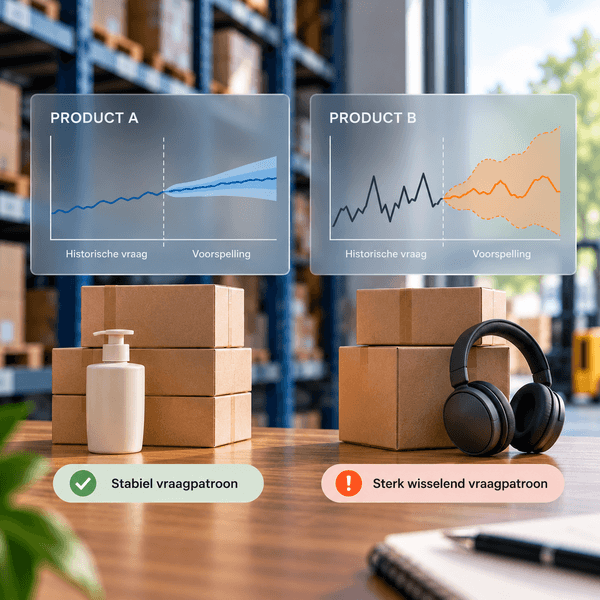
No. A demand forecast remains a prediction, and actual demand can always turn out differently. That is precisely why it is important not just to look at expected demand, but also to account for the uncertainty around that forecast.
That uncertainty also differs per SKU. A product with a stable sales pattern is generally easier to forecast than an item with large swings in demand. Good demand planning therefore accounts for differences between products and updates forecasts as new information becomes available.
Demand planning and inventory optimisation
Stocktimal helps companies forecast future demand and translate these insights into stock decisions. A forecast model and planning horizon can be chosen per SKU, matched to that product's demand pattern.
Stocktimal then combines demand forecasting with inventory optimisation. This gives you insight not only into what you are expected to sell, but also support for questions like how much to order and when. That makes demand planning directly applicable to day-to-day inventory management.
Demand planning with Stocktimal
At Stocktimal, we help companies forecast future demand and translate these insights into stock decisions. A forecast model and planning horizon can be chosen per SKU.
We then combine these demand forecasts with up-to-date stock information to show you how much to order and when. That makes demand planning directly applicable to day-to-day inventory management. Want to find out what Stocktimal can do for your demand planning and inventory optimisation? Request a free trial run or get in touch with us for more information.