Services
Help getting started, if you want it
Stocktimal is made to be used on your own afterwards, but a good start usually does take some setting up and alignment. Think of connecting the data, configuring the constraints and working through the first results. We keep that support as practical and as limited as we can. After that, Stocktimal can be used without an ongoing consulting engagement.
We know where these projects tend to get stuck
The maths is rarely the problem. The challenge usually sits in data and processes: stock is in one system, purchase history in another, lead times are based on agreements rather than measured performance, and product groups do not always match how planning actually happens.
Situations like that are common. So we know which questions to ask early and where data usually has to be cleaned up or filled in first. Together with our experience in data processing and automation, that helps implementations run faster and in a more structured way.
At the same time, nobody knows your operation better than you do. So every implementation is a collaboration: we bring the methodology and the technical experience, you bring the knowledge of catalogue, suppliers and processes.
Four parts — only where you need them
Roughly in the order they come up.
Configuration and setup
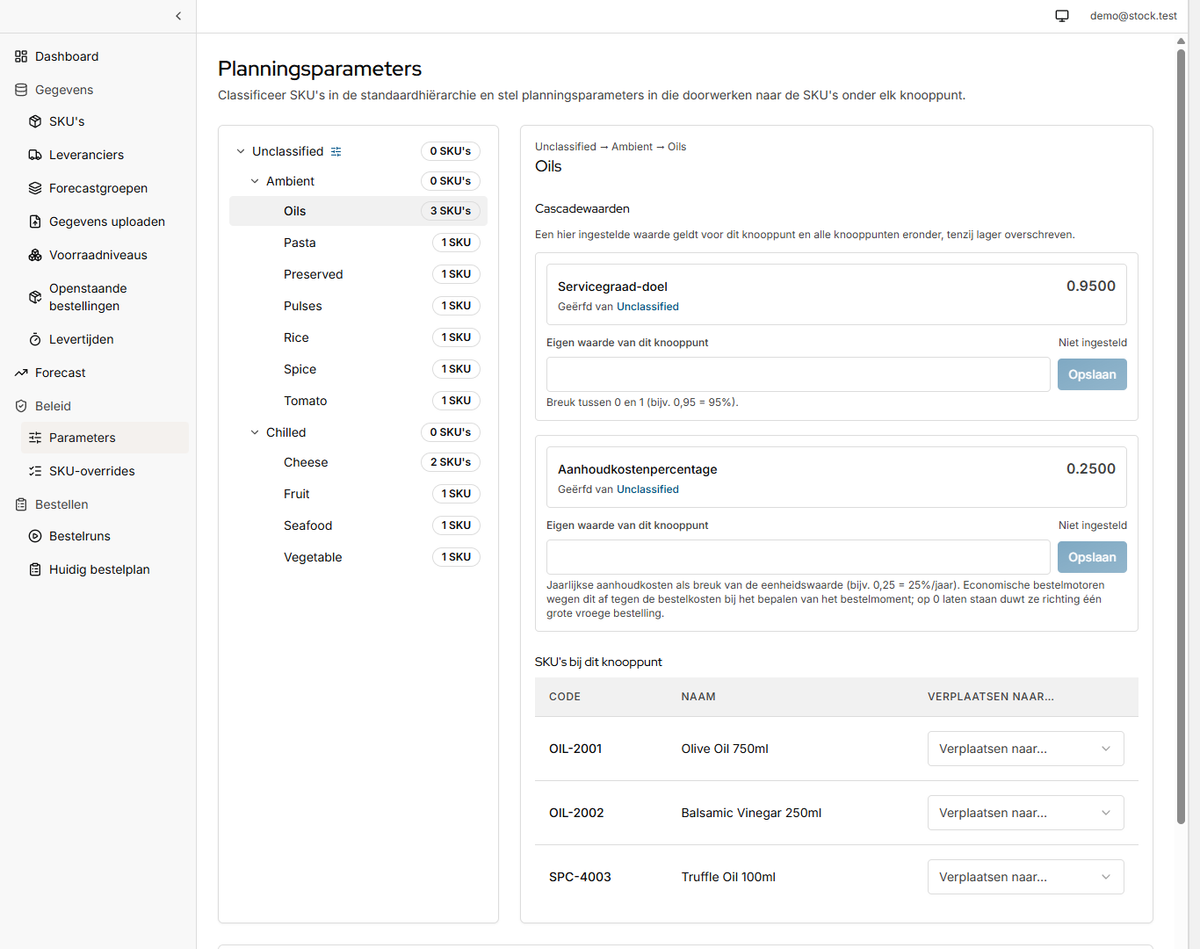
We set up the catalogue, suppliers and sourcing options so they match the way planning actually happens — not just how the data happens to sit in the ERP.
Data analysis
First we look at what the history actually shows. What patterns are there in demand, which product groups matter, and where are the anomalies in the data? This is usually the point at which the biggest surprises come to the surface.
Calibrating the demand models
Stocktimal compares statistical, machine-learning, neural and foundation models and works out which approach works best. That choice can be made for the whole catalogue, but also per SKU or per forecast horizon. So the model choice matches the way demand actually behaves.
Automating the routine
Once the setup is in place and the data is right, much of the recurring work can be automated. That leaves more time for review, exceptions and the actual purchasing decision.
Not every company needs all four parts. We work out together where support genuinely adds value, rather than offering a full implementation programme as standard.
It starts with the data, not with a project plan
How much implementation is needed shows mainly in the data. How are your catalogue and suppliers set up? What can you already export, and what still needs cleaning up?
A first overview lets us establish early on what support is needed and what the implementation is expected to cost.
What we don't do
No ERP integrations and no S&OP process consulting. We would rather stay close to what we are good at: data, forecasting, optimising and automating.
A free trial run on your own catalogue
One export is enough: sales history, current stock and open orders. We forecast your demand per SKU and show you what Stocktimal would order on that basis — next to what you actually ordered, with the differences explained. You keep the output, even if nothing comes of it. No integration, no access to your ERP and no implementation project. Just one file.