
You can improve product availability by forecasting expected demand accurately, holding the right safety stock, and ordering new stock on time. That reduces the risk of stock-outs without carrying more stock than you need. This blog covers the factors that determine product availability and how to improve them structurally.
This blog in short
- Improving product availability starts with insight into future demand.
- The right safety stock helps absorb unexpected demand and uncertainty.
- The right reorder point depends on demand, stock position and lead time, among other factors.
- Inventory optimisation helps combine high product availability with an efficient stock level.
What is product availability?
Product availability indicates how often a product is available at the moment a customer wants to order it. High product availability means you can meet demand immediately in most cases.
Low product availability increases the risk of lost sales, missed revenue and dissatisfied customers. Yet simply buying more is not the answer. Too much stock ties up working capital and can lead to higher storage costs and obsolete inventory.

How can you improve product availability?
You improve product availability by aligning stock decisions more closely with expected demand. That means knowing not just how much stock is available today, but above all how much you're likely to need until new stock arrives.
In practice, this comes down to a combination of reliable demand forecasts, up-to-date stock data, lead times, open orders and an appropriate safety stock. Assessing these factors together lets you anticipate potential stock shortages earlier.
Demand forecasting as the basis for optimal stock
A good demand forecast shows how much of a product you're likely to sell. It's usually based on historical sales data, where trends, seasonal patterns and shifts in demand can all be relevant.
Looking only at average historical sales is therefore often not enough. A product that sells roughly the same quantity every week calls for a different stock strategy than a product with sales that swing widely. It's precisely those differences between SKUs that matter when determining the right stock level.

How does safety stock support product availability?
Safety stock is an extra buffer that absorbs uncertainty in demand and supply. It can prevent a product from selling out immediately when demand is temporarily higher than expected or a delivery is delayed.
How much safety stock you need differs per product. Factors such as demand variability, supplier reliability, lead time and the desired service level all play a role. An appropriate safety stock is therefore best set per SKU, rather than as a single fixed buffer across the whole assortment.
When should you order new stock?
The right reorder point is determined by the stock you're expected to need during the lead time, plus an appropriate safety stock. Wait too long to order, and the risk of a stock-out increases. Order too early as a rule, and average stock can build up unnecessarily.
Say a supplier has a lead time of four weeks. For a new order, you then need to look not only at today's stock, but also at expected demand over those four weeks and any uncertainty in it. Open orders should also be factored in, so you don't order more than necessary.

Is more stock the answer to better product availability?
No. More stock can lower the risk of a stock shortage, but that doesn't automatically mean your stock is set up optimally. Higher stock also brings costs and risks of its own.
The goal, then, isn't the highest possible product availability at any cost. You're looking for a balance that delivers the desired service level with as little unnecessary stock as possible. What that optimal balance looks like can differ by product and by organisation.
Inventory optimisation and product availability
Inventory optimisation brings demand, stock and delivery information together to support better stock decisions. That way you spot looming shortages earlier and see where too much stock is being held.
Across hundreds or thousands of SKUs, it's hard to manually account for differences in demand patterns, lead times and safety stocks. Data-driven inventory optimisation makes it possible to factor in these differences systematically.
The approach doesn't have to be the same for every SKU. By taking into account, per product, factors such as the demand pattern, lead time, order windows and shelf life, you can align stock more closely with the desired product availability.
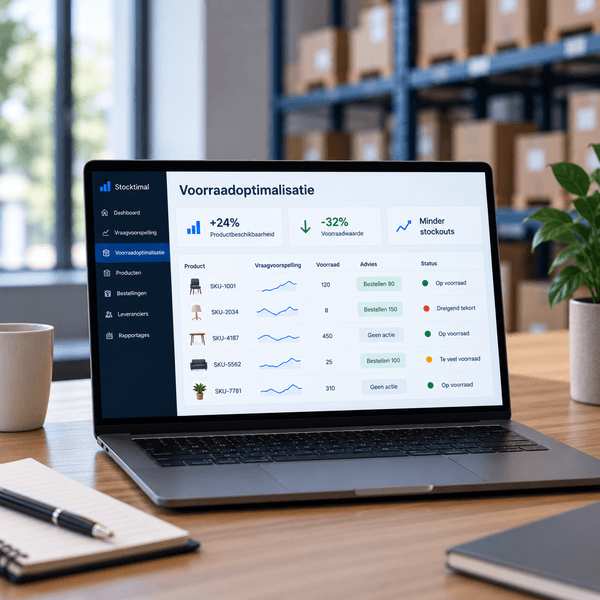
Improving product availability with Stocktimal
At Stocktimal, we help companies improve their product availability with data-driven demand forecasting and inventory optimisation. Our platform uses sales history, current stock and open orders, among other inputs, to give you insight into future stock needs.
We account for differences and uncertainty in demand per SKU. That gives you support on key questions such as which products to order, how much you need, and when to order. The goal is to achieve the desired product availability without carrying more stock than necessary.
Want to know where your stock has room to improve product availability? Request a free trial run or get in touch with us for more information.